Is your vehicle’s performance starting to feel a little "off"? Maybe it’s pulling slightly to the left, or you’ve noticed that your steering wheel isn’t quite as responsive as it used to be. Many drivers ignore these subtle warning signs, only to face a massive repair bill or a set of bald tires long before they should have needed replacement. The secret to avoiding these headaches isn't a complex, expensive upgrade—it’s a simple, routine maintenance task, part of a comprehensive tire care regimen: tire rotation.
If you’ve been asking yourself, "How often should I rotate my tires?" you aren't alone. Many drivers are keen to understand How Often Should You Rotate Tires to ensure optimal vehicle performance. In 2026, keeping your vehicle in top shape is about more than just convenience; it’s about safety, fuel economy, and protecting your investment. Whether you are driving an electric vehicle, a rugged 4WD truck, or a standard commuter sedan, understanding How Often Should You Rotate Tires and the cadence of regular tire maintenance is the most effective way to keep your ride smooth and your wallet full, helping to maximize tire longevity and ensure enhanced vehicle stability.
Why Tire Rotation Is Non-Negotiable in 2026
At its simplest level, tire rotation involves moving your tires from one position on your vehicle to another—for example, swapping the front tires to the rear or side-to-side. Understanding How Often Should You Rotate Tires is crucial because tires do not wear evenly. Depending on your drivetrain (FWD, RWD, or AWD) and your driving habits, the tires on the front axle often experience significantly more stress than those on the rear.
When you allow tires to remain in the same position for too long, one or two tires will inevitably "bald" or wear down much faster than the others. This leads to compromised handling, reduced traction during wet or slippery weather, and an uneven ride that can even damage your vehicle's suspension system. By regularly rotating your tires, you ensure that the wear is distributed across all four tires, effectively helping to maximize tire longevity and saving you the cost of a full set of replacements well before the end of their predicted mileage.
Recommended Intervals: What the Experts Say
While opinions might vary slightly, the consensus among automotive experts in 2026 is clear regarding How Often Should You Rotate Tires. Most drivers should aim to rotate their tires every 5,000 to 7,500 miles, aligning with manufacturer’s recommended intervals. This timeline is designed to catch uneven wear patterns early before they become permanent damage.
For many, the easiest way to remember this is to schedule your rotation during every other oil change. Because most modern vehicles have specific maintenance schedules, aligning these two services ensures you never forget a vital check-up.
Drivetrain-Specific Rotation Cycles
Your vehicle’s drivetrain dictates how quickly and in what pattern your tires wear, directly influencing How Often Should You Rotate Tires. Here is how you should adjust your schedule based on your specific vehicle type:
- Front-Wheel Drive (FWD): Since the front tires handle steering, braking, and the power of the engine, they endure the most stress. For FWD vehicles, knowing How Often Should You Rotate Tires means aiming for a rotation every 5,000 to 7,000 miles.
- Rear-Wheel Drive (RWD): On these vehicles, the rear tires handle the bulk of the power delivery. When considering How Often Should You Rotate Tires for RWD, you can typically push your rotation interval slightly further, aiming for every 6,000 to 8,000 miles.
- AWD / 4WD Systems: These systems are highly sensitive to tread depth differences. To protect your drivetrain from expensive damage caused by mismatched tire sizes, understanding How Often Should You Rotate Tires for AWD/4WD means rotating more frequently, roughly every 5,000 to 6,000 miles.
- Electric Vehicles (EVs): Because of the instant, high torque provided by electric motors, tires on EVs often wear differently. When asking How Often Should You Rotate Tires for an EV, check your owner's manual, but generally, stick to the 5,000-mile mark to ensure maximum longevity.
Warning Signs That You’re Overdue
If you’ve skipped your last few maintenance cycles, your car might be trying to tell you it’s time for a visit to the mechanic. These warning signs often indicate you haven’t been rotating your tires as frequently as recommended. You don’t need to be a professional technician to spot the warning signs of uneven tire wear, including specific tire wear patterns like feathering or heel-toe wear, which can help you determine How Often Should You Rotate Tires in the future. Keep an eye out for these three red flags:
1. Unusual Vibrations
If you feel a rhythmic shaking or vibration coming through the steering wheel or seat, especially at highway speeds, it is often a sign of uneven wear or a loss of balance. Don't ignore this; it can lead to further damage to your steering components.
2. Noticeable Uneven Tread
Take a walk around your car once a month. Run your hand across the treads of each tire. If one tire feels significantly smoother or "balder" than its neighbor, your rotation schedule is far behind. This is a clear indicator that your tires are not working in harmony.
3. Pulling to One Side
When you are driving on a straight, flat road, does your car seem to drift toward one side? While this can sometimes indicate a wheel alignment issue, it is also frequently caused by uneven tire wear that has altered the way your vehicle makes contact with the road.
The Financial Benefits of Consistent Maintenance
It’s easy to look at the cost of a tire rotation—usually a modest fee—and wonder if you can just skip it. However, the financial argument for regular rotation, and understanding How Often Should You Rotate Tires, is overwhelming. When tires wear unevenly, you are forced to replace them long before their natural "end-of-life" mileage.
By investing in a rotation every 5,000 to 7,500 miles, you are essentially buying "insurance" for your tires. You are keeping the tread consistent, which maintains optimal fuel efficiency and improves braking performance. Furthermore, many tire manufacturers actually require regular rotations to keep your warranty valid. If you encounter a defect and haven't kept a log of your rotations, you could be left footing the bill for a full replacement that should have been covered.
How to Establish a "Set-It-and-Forget-It" Schedule
The biggest barrier to proper maintenance, including knowing How Often Should You Rotate Tires, is simply forgetting. To stay on top of your game in 2026, use these simple tips:
- Create a Log: Keep a small notebook in your glovebox or use a digital app to track every service appointment. Staple your receipts to the log.
- Use the "Oil Change Rule": As mentioned earlier, tie your rotation to your oil change. This helps answer the question of How Often Should You Rotate Tires in a practical way. If your car requires synthetic oil with longer change intervals, set a calendar alert for every 5,000 miles regardless.
- Check the Manual: Your vehicle’s manufacturer provides the most accurate information for your specific make and model regarding How Often Should You Rotate Tires. Always consult your owner’s manual guidelines; if they suggest a different interval than the general rule of thumb, prioritize the manufacturer's guidance.
Consistency is the ultimate key. Whether you do it yourself in your garage or take your car to a trusted dealership or service center, the act of moving those tires around is a vital, high-return investment in your vehicle’s health.
The Hidden Mechanics: How Rotation Affects Your Suspension
Many drivers view tire rotation as a superficial task, akin to cleaning the exterior of a vehicle. However, the impact of uneven tires, often a result of not knowing How Often Should You Rotate Tires, extends deep into the structural integrity of your car. Your suspension system is designed to work in tandem with a balanced set of tires. When tread depths vary across the four corners of your vehicle, the suspension must compensate for these differences, often leading to premature degradation of expensive components like bushings, struts, and shocks (Source 3).
By ensuring your tires are rotated regularly, often combined with wheel balancing, you are not just caring for the rubber; you are shielding your entire chassis from unnecessary mechanical stress. Consider the following ways that balanced tires protect your investment:
- Minimizes Suspension Strain: Balanced tires ensure that each corner of the vehicle experiences consistent ground contact, preventing the suspension from "bottoming out" or absorbing excessive road shock on one side due to thinner tread (Source 3).
- Maintains Optimal Alignment: While rotation isn't a replacement for a professional wheel alignment service, keeping tread wear even makes it much easier for your vehicle to hold its geometry, preventing the "pulling" sensation often associated with misaligned wheels.
- Protects Drivetrain Components: In AWD and 4WD vehicles, the computer systems rely on consistent tire diameters to manage power distribution. Uneven tires can "trick" these sensors, causing the differential to work harder than necessary and leading to catastrophic internal failure (Source 1).
Debunking the Myth of "Over-Rotation"
A common question that arises among meticulous vehicle owners is How Often Should You Rotate Tires, and whether it is possible to rotate them too often. While the standard advice encourages an interval of 5,000 to 8,000 miles, aligning with manufacturer’s recommended intervals, some enthusiasts wonder if doing it more frequently provides better results. The reality is that while you cannot physically "harm" your tires by rotating them too often, there are diminishing returns on your time and money (Source 6).
Focusing on the optimal window ensures you balance safety with practicality. If you rotate your tires every 500 miles, you are simply incurring labor costs without any measurable gain in tread uniformity. Conversely, ignoring the rotation for 15,000 miles creates "locked-in" wear patterns that are impossible to reverse.
Indicators That Your Rotation Cycle Needs Adjustment
While the 5,000-mile standard is excellent for the average commuter, certain driving styles necessitate a more aggressive schedule for How Often Should You Rotate Tires. You should consider accelerating your rotation frequency if you notice any of the following factors:
- Aggressive Cornering: If your daily commute involves frequent, sharp turns, your front tires will degrade much faster than they would in highway-heavy driving.
- High-Load Cargo: Regularly hauling heavy equipment or towing a trailer changes the pressure distribution on your rear tires, requiring a tighter rotation cycle to counteract premature wear.
- Variable Road Surfaces: Driving on unpaved or abrasive road surfaces accelerates tread loss. If your tires are constantly subjected to gravel or rough terrain, move your rotation interval to the lower end of the spectrum, around 4,000 miles (Source 3).
Understanding the "Rotation Pattern" for Your Vehicle
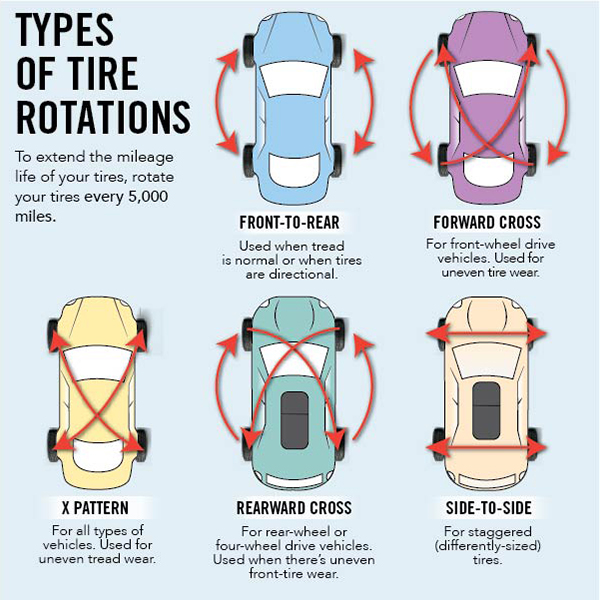
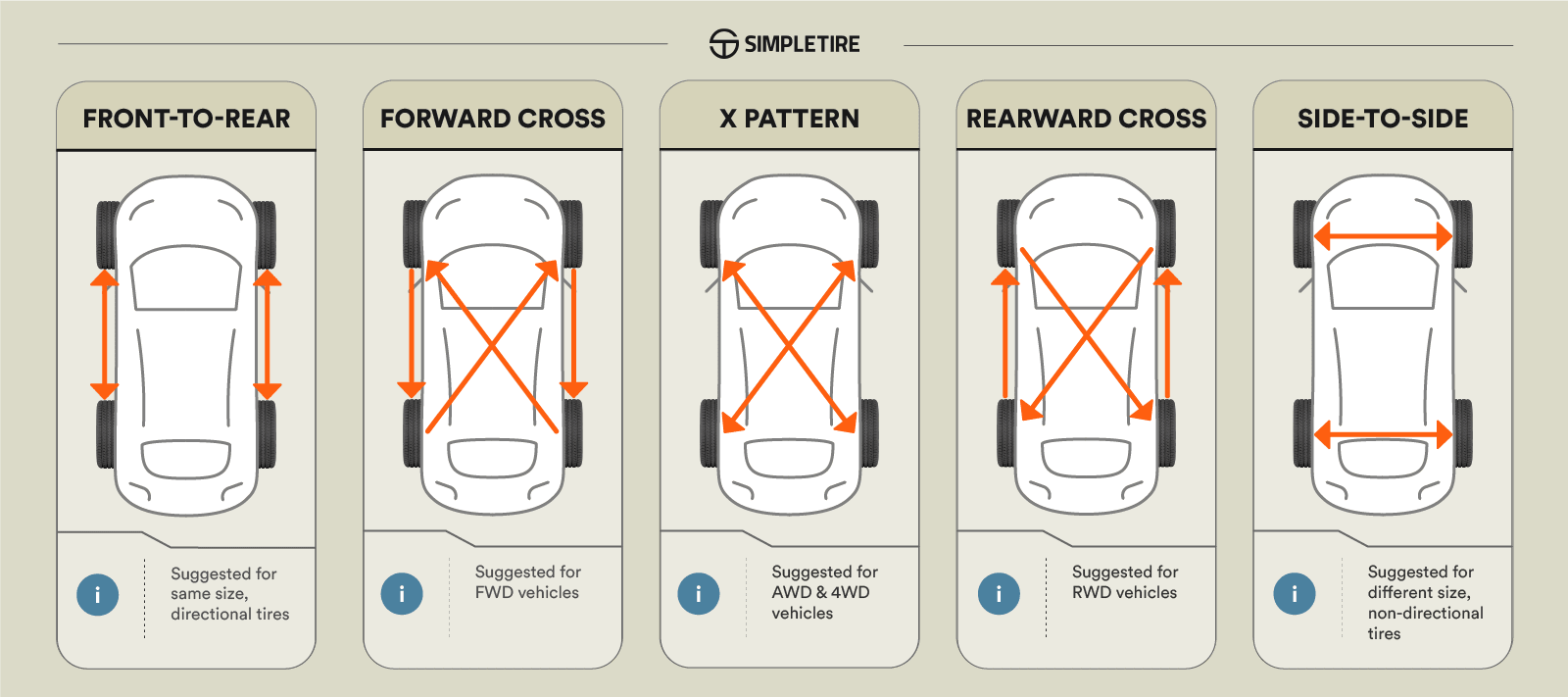
Not all rotations are created equal. The pattern used by a technician depends entirely on your vehicle's drivetrain and the type of tires equipped on your car. Understanding these patterns is essential, especially when determining How Often Should You Rotate Tires and if you choose to perform a DIY tire rotation yourself in your home garage.
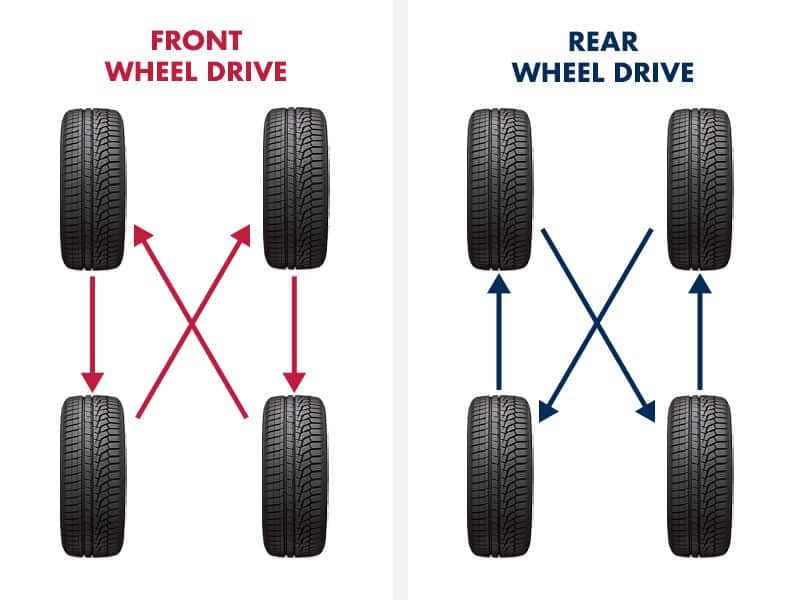
- Forward Cross: This is the most common pattern for FWD vehicles. The front tires are moved to the rear in their same side positions, while the rear tires are moved to the front and crossed to opposite sides.
- Rearward Cross: Typically used for RWD or 4WD vehicles. The rear tires move to the front, and the front tires are moved to the rear and crossed to opposite sides.
- Side-to-Side: Used for vehicles with directional tires or staggered fitments where the rear wheels are physically wider than the front. In this scenario, tires are simply swapped from left to right on the same axle (Source 3).
Why Manufacturers and Dealerships Emphasize Documentation
One of the most overlooked aspects of tire maintenance is the "Paper Trail." In the modern automotive world, receipts are as valuable as the tires themselves. Many consumers don't realize that the tire manufacturer’s warranty—which often covers up to 60,000 or even 80,000 miles—is contingent upon you proving that you maintained the tires according to the manufacturer’s recommended intervals, including documentation of How Often Should You Rotate Tires (Source 1).
If you experience a premature tread separation or a blowout due to a defect, the manufacturer will ask for documentation of your service history. If you have been performing the rotations yourself, keep a detailed logbook, including the date, mileage, and the specific rotation pattern utilized. If you have a professional perform the work, ensure the invoice specifically notes the tire service.
Essential Data to Log for Warranty Protection
To ensure you never face a denied warranty claim, your maintenance log should include the following entries for every service:
- Exact Odometer Reading: Record the mileage at the moment of the rotation.
- Tread Depth Measurements: Using a simple gauge, write down the depth in 32nds of an inch for each tire. This provides objective proof that you are monitoring the health of the rubber.
- Technician Notes: If the mechanic notices anything unusual, such as a slight pull or a suspected alignment issue, document those comments. This can be critical evidence if a major failure occurs later.
- Specific Rotation Pattern: Indicate whether you used a forward, rearward, or side-to-side pattern.
The Intersection of Tire Pressure and Rotation
You cannot discuss the longevity of your tires, or truly answer How Often Should You Rotate Tires, without addressing the "silent killer" of tire performance: incorrect inflation pressure. A tire rotation, while essential, will not save a tire that has been driven under-inflated or over-inflated for thousands of miles.
In fact, one of the most effective ways to see if your rotation schedule is working is to monitor your tire pressure regularly. If you find one tire consistently loses pressure faster than others, it may have a slow leak or a damaged bead. Rotating that tire to a different position will not fix the issue; it will only mask it until you are stuck on the side of the road. In such cases, exploring tire repair options might be necessary before rotation.
The Synergistic Benefits of Proper Care
When you combine regular rotations with proper inflation habits, you create a synergy that extends the life of your tires far beyond the manufacturer’s estimates:
- Maintained Rolling Resistance: Correctly inflated and evenly worn tires provide the lowest possible rolling resistance, directly improving your fuel economy and lowering your carbon footprint.
- Predictable Braking Distances: When all four tires have equal grip, the ABS (Anti-lock Braking System) can perform optimally. If one tire is significantly more worn than the others, it can cause the system to trigger prematurely, increasing your stopping distance (Source 6).
- Noise Reduction: Unevenly worn "cupped" tires create a distinct, loud humming noise on the road. Rotating tires prevents this cupping pattern from forming, keeping your cabin quiet and your ride smooth.
The True Cost of Neglecting Your Tires
There is a pervasive belief among budget-conscious drivers that skipping a tire rotation, or not knowing How Often Should You Rotate Tires, is a valid way to save money. This is a dangerous misconception. When you neglect this service, you are essentially "pre-paying" for a new set of tires while your current set is still in its prime.
Consider the math: a set of high-quality tires can easily cost $800 to $1,200. If you rotate them every 5,000 to 7,500 miles, you ensure you get the maximum value from that investment. If you skip this, you might end up replacing those tires after 30,000 miles instead of 50,000 miles. That is a loss of 20,000 miles of usable rubber, which effectively increases the "cost-per-mile" of your vehicle by nearly 40 percent (Source 4).
Furthermore, the secondary costs associated with tire neglect are often even higher. A blowout caused by excessive, uneven wear can lead to:
- Rim Damage: Driving on a shredded tire can permanently bend or crack your wheels.
- Fender and Body Damage: When a tire explodes, it often detaches, causing significant damage to your vehicle's wheel wells, brake lines, and body panels.
- Increased Insurance Premiums: If you lose control of your vehicle due to a tire failure, you may be held liable for accidents, leading to increased insurance rates that far outweigh the cost of a few simple maintenance visits.
Seasonal Considerations: When to Rotate During Tire Changes
For those living in climates that require seasonal tire changes—such as swapping between summer performance tires and dedicated winter tires—the rotation process becomes even simpler. Many drivers find that the best time to rotate, and thus answer the question of How Often Should You Rotate Tires, is during the seasonal change-over.
When you remove your winter tires for storage, take the time to mark their position on the vehicle (e.g., "Left Front," "Right Rear"). When you reinstall them the following season, rotate their positions. This ensures that even with the seasonal storage interval, the tires are seeing an even distribution of the vehicle's weight and steering forces over their total lifespan.
Tips for Seasonal Tire Storage and Rotation
- Label Each Tire: Use a tire marker or a simple piece of painter's tape to label the position where each tire was removed.
- Inspect Before Storage: Check for any debris, nails, or cuts before placing them into storage. It is better to repair a flat tire in the garage than to realize it's damaged when you need it most.
- Rotate Upon Reinstallation: Always install tires in a different position than where they were removed to ensure the "wear pattern" continues to migrate around the vehicle.
Choosing the Right Service Provider
While many drivers are capable of performing basic maintenance, there is significant value in having your tires rotated by a professional. They can also provide expert advice on How Often Should You Rotate Tires for your specific vehicle and driving habits. A tire shop or dealership has access to specialized equipment, such as high-speed balancers, which can identify issues that the naked eye might miss.
When you bring your vehicle in for a rotation, a professional technician will often perform a multi-point inspection that covers more than just the tires. They will check your brake pads, look for suspension leaks, and verify that your tire pressures are set to the manufacturer's specific PSI requirements. They can also perform a professional wheel balancing service to ensure optimal ride quality. This is a level of preventive maintenance that provides peace of mind and keeps your vehicle performing at its factory-best standard (Source 2).
Questions to Ask Your Technician
When you drop your vehicle off, don't be afraid to ask questions, especially concerning How Often Should You Rotate Tires for your specific model. A qualified shop will be happy to provide transparency regarding the health of your tires. Ask these specific questions to ensure you are getting the full value of the service:
- "What is the current tread depth of each tire?" Getting an exact measurement helps you predict when you will need to budget for a replacement.
- "Did you notice any abnormal wear patterns, such as feathering or cupping?" This feedback can alert you to alignment or suspension issues before they manifest as a major repair.
- "Is my spare tire included in the rotation?" If your vehicle has a full-size spare, it should absolutely be included in your rotation schedule to ensure it is ready for use.
- "How does the wear on my front tires compare to the rear?" This will give you insight into your personal driving habits and whether you need to adjust your interval for the future.
Long-Term Maintenance: The Evolution of Tire Tech in 2026
As we advance through 2026, tire technology continues to evolve. Modern compounds are designed for lower rolling resistance and better wet-weather grip, but they are also more sensitive to alignment and balance. As vehicle weights increase—partially due to the integration of heavier battery packs in EVs—the stress on individual tires has shifted, making the question of How Often Should You Rotate Tires even more nuanced.
The "traditional" rules of maintenance are being updated to reflect these realities. For example, the instant torque characteristic of electric vehicles means that front tires may wear faster in some models, or rear tires in others, depending on where the drive motors are located. Relying on outdated advice from a decade ago is no longer sufficient.
Adapting to the Modern Fleet
- EV-Specific Tires: Many electric vehicles now use tires with a higher load rating and specialized tread patterns. These tires are often more expensive, making the rotation schedule even more critical for protecting your initial investment.
- Sensor-Equipped Wheels: Modern TPMS (Tire Pressure Monitoring Systems) are more sensitive than ever. Ensure your rotation service includes a TPMS relearn procedure, as some vehicles require the onboard computer to be updated so it knows which tire is in which position.
- Aerodynamic Wheel Covers: Many newer vehicles, especially hybrids and EVs, feature aero covers. Make sure your service shop is equipped to handle these specialized components without damaging them during the removal process.
How to Handle Mismatched Tread Depth
Sometimes, through neglect or a flat tire, you may end up with a set of tires that have significantly different tread depths. This is a common dilemma that impacts the decision of How Often Should You Rotate Tires. Should you rotate them, or is it better to replace them?
The general rule of thumb is that if the tread depth difference between tires on the same axle exceeds 2/32 of an inch, you may encounter compromised handling performance and reduced vehicle stability. In this case, you should prioritize keeping the two tires with the most tread on the rear axle, as this provides better stability in wet conditions and reduces the likelihood of hydroplaning.
Step-by-Step Strategy for Uneven Sets
- Measure All Four: Use a professional-grade tread depth gauge.
- Identify the Best Two: Place the two tires with the deepest tread on the rear axle to maintain vehicle stability.
- Monitor the Front: The two tires with slightly less tread will move to the front, where they will naturally wear down slightly faster, eventually bringing the set closer to a uniform depth.
- Consult a Professional: If the difference is severe, it is safer to replace the tires in pairs or sets rather than attempting to "even them out" through rotation.
Safety: The Ultimate Motivation
Beyond the financial savings and the performance benefits, the most compelling reason to rotate your tires, and to understand How Often Should You Rotate Tires, is safety, ensuring enhanced vehicle stability and predictable handling performance in all conditions. A vehicle’s tire is the only point of contact between you and the road. Every safety feature—your airbags, your anti-lock brakes, your traction control system—relies entirely on that small patch of rubber gripping the pavement.
When you allow your tires to wear unevenly, you are essentially reducing the effectiveness of every other safety system in your car. A tire with low tread depth in the front will struggle to bite into the road during a sudden emergency stop, potentially adding critical feet to your braking distance. Those few feet are often the difference between a near-miss and an unfortunate collision.
The Psychological Benefit of Proactive Maintenance
There is a distinct feeling of confidence that comes with knowing your vehicle is in top mechanical condition. When you adhere to a 5,000 to 7,500-mile rotation schedule, and truly understand How Often Should You Rotate Tires, you remove the "uncertainty factor" from your daily commute. You aren't constantly wondering if your car is about to let you down; you have the peace of mind that comes from knowing you have fulfilled your responsibility as a car owner, through comprehensive tire care.
This sense of reliability extends to your family, your passengers, and the other drivers on the road. By maintaining your vehicle correctly, you are contributing to a safer driving environment for everyone.
The Role of Driving Style in Tire Longevity
While we have discussed the mechanical and schedule-based aspects of tire rotation, and by extension How Often Should You Rotate Tires, it is important to acknowledge that your personal driving style is a major variable. Every driver has a unique "signature" on their tires based on how they accelerate, brake, and corner.
If you are a driver who tends to take corners quickly, you will likely notice higher wear on the outer shoulders of your tires. This "shoulder wear" is a classic sign of aggressive driving. Regular rotation is the only way to counteract this, as it allows the other, less-stressed parts of the tire to take over the load in a different position on the vehicle.
Techniques to Extend Tire Life Through Driving
- Gentle Acceleration: Avoid "jack-rabbit" starts, which place a massive amount of torque on the drive tires and strip away rubber far faster than normal cruising.
- Anticipatory Braking: Look ahead and coast to a stop when possible. Heavy, last-minute braking increases the surface heat of the tire, which softens the rubber and makes it more susceptible to abrasion.
- Consistent Speeds: Maintaining a steady, moderate speed on the highway allows for more uniform temperature distribution across the tire’s contact patch, which is vital for long-term tread stability.
Troubleshooting Rotation-Induced Vibrations
Occasionally, a driver might notice that a car develops a slight vibration immediately after a tire rotation. This is a common concern, and it might make you question How Often Should You Rotate Tires, but it rarely means that the rotation itself was the problem. Instead, it usually points to a pre-existing issue that was previously "hidden" by the tires' old positions.
If you experience this, don't panic. It is often a result of uneven wear patterns finally meeting a new axle position, or it may indicate that the tires were not subjected to a proper wheel balancing during the rotation.
How to Fix Post-Rotation Issues
- Check for Balance: If you feel a vibration after a rotation, take the vehicle back and ask the shop to perform a "road force balance." This is a more comprehensive way to ensure each wheel is perfectly balanced.
- Verify Pressure: Sometimes, a technician might accidentally set the pressures differently on the new positions. Double-check that all four tires are inflated to the exact PSI listed on your driver's side door jamb.
- Alignment Check: If the vibration persists after a re-balance, it is highly likely that your vehicle is out of wheel alignment. A professional wheel alignment service will ensure that the tires are sitting flat on the road, which will eliminate the vibration and stop the uneven wear.
The Future of Tire Maintenance
Looking ahead, we can expect to see more integration between vehicles and their tires. We are already seeing "smart tires" that feature embedded sensors to report tread depth and temperature directly to your smartphone. These advancements will make the question "How often should I rotate my tires?" (or rather, How Often Should You Rotate Tires) even easier to answer, as your car will literally tell you when the tread depth difference warrants a swap.
Until that technology becomes universal, however, the manual discipline of the 5,000 to 7,500-mile interval remains your best tool for success. It is a simple, effective, and high-impact habit that separates the vehicle owners who "get by" from those who truly master their ownership experience.
Building Your Own Maintenance Roadmap
To truly succeed in 2026, you need a plan that includes a clear understanding of How Often Should You Rotate Tires. Don't rely on your memory—it's too easy to lose track when life gets busy. Use the following framework to build your own "Tire Health Roadmap" and ensure you stay on track regardless of how busy your schedule becomes:
Your Personal Maintenance Checklist
- Phase 1: The Baseline. Measure your tread depth today. Write it down in a digital note or a dedicated glovebox log. Note the date and your current mileage.
- Phase 2: The Trigger. Set a recurring calendar notification for every 5,000 miles, reminding you How Often Should You Rotate Tires. This isn't a suggestion; it's a mandatory appointment for your vehicle's health, forming a core part of your comprehensive tire care strategy.
- Phase 3: The Audit. During every rotation, which confirms you’re following the recommended schedule for How Often Should You Rotate Tires, ask for a written report of the tread depth. Keep these receipts in a folder. If you ever have a dispute with a tire manufacturer, you will be the most prepared person in the room.
- Phase 4: The Inspection. Once a month, do a "walk-around." Check for nails, glass, or uneven wear. A five-minute investment today can save you from a two-hour delay on the side of the road tomorrow.
By treating your tires with the respect they deserve, you are not just maintaining a machine; you are securing your safety and protecting your hard-earned income from the unnecessary costs of neglect, ensuring maximize tire longevity and optimal handling performance. The next time you find yourself at the 5,000-mile mark, remember the importance of How Often Should You Rotate Tires. Don't put it off. Schedule that rotation. Your car, your wallet, and your peace of mind will thank you for it.
References
-
Yourautovision — How Often Do I REALLY Need to Rotate My Tires?, 2026
-
Consumerreports — How Often Should You Rotate Your Tires? – Consumer Reports, 2026
-
Usatoday — How often should you rotate your tires? – USA TODAY, 2026
-
Autozone — How Often Do You Need to Rotate Your Car Tires? – AutoZone, 2026
-
Edmunds — Tire Rotation: How To and How Often – Edmunds, 2026
-
Thetirereviews — Can You Rotate Tires Too Often? – The Tire Reviews, 2026
-
Familyhandyman — Everything to Know About Tire Rotations, Explained, 2026
-
Michelinman — Tire Rotation Guide: Vehicle Types & Care – Michelin USA, 2026