The automotive landscape has shifted dramatically over the last few years. If you are standing in a dealership lot or browsing online inventory today, you are no longer choosing between simple gas-guzzlers and niche eco-friendly alternatives. Instead, you are faced with a highly sophisticated spectrum of electrification.
The central dilemma for most modern buyers boils down to a single question: Hybrid vs Electric Cars: Which One Should You Buy?
With battery technology advancing rapidly, public charging networks undergoing massive overhauls, and fuel prices remaining highly unpredictable, making the right choice requires looking closely at your driving habits, budget, and living situation. This comprehensive guide breaks down everything you need to know to make an informed, future-proof decision in 2026.
Understanding the Contenders: HEV, PHEV, and BEV
Before diving into costs and infrastructure, we must clarify what we are actually comparing. The term “hybrid” is no longer a one-size-fits-all label. Today, electrified vehicles fall into three distinct categories.
1. Traditional Hybrids (HEVs)
A Hybrid Electric Vehicle (HEV) uses both an internal combustion engine (ICE) and a small electric motor.
How it works: The battery pack is charged entirely through regenerative braking and the gas engine itself.
The driving experience: You never plug it in. You pump gas just like a conventional car, but you enjoy significantly higher fuel economy—often exceeding 50 MPG in city driving.
2. Plug-In Hybrids (PHEVs)
A Plug-In Hybrid Electric Vehicle (PHEV) is the ultimate middle ground. It features a larger battery pack and a more powerful electric motor paired with a traditional gas engine.
How it works: You can plug it into an electrical outlet or charging station.
The driving experience: A typical PHEV offers an all-electric range of 30 to 50 miles—perfect for daily commutes. Once the battery runs dry, the car automatically switches to operating like a standard hybrid, eliminating any threat of range anxiety.
3. Battery Electric Vehicles (BEVs / EVs)
A Battery Electric Vehicle (BEV), commonly referred to simply as an EV, is powered 100% by electricity.
How it works: There is no gas engine, no tailpipe, and no fuel tank. It relies entirely on a massive under-floor battery pack and one or more electric motors.
The driving experience: You must plug it in to keep it running. Modern EVs in 2026 offer driving ranges typically spanning from 250 to over 400 miles on a single charge.
Total Cost of Ownership: Which Option Saves More in 2026?
When analyzing Hybrid vs Electric Cars: Which One Should You Buy?, financial viability is usually the deciding factor. To determine the true cost of ownership, we must look beyond the initial sticker price and calculate fuel, electricity, maintenance, and insurance costs.
Purchase Price and Depreciation
Historically, fully electric vehicles carried a massive premium over their hybrid counterparts. In 2026, that gap has narrowed significantly due to falling battery manufacturing costs and standardized production lines. However, traditional hybrids still hold a slight edge in terms of lower upfront purchase prices.
Hybrids: Generally cost only $1,500 to $3,000 more than equivalent gas-only models.
EVs: Often carry a higher base price, but they frequently qualify for federal, state, or local tax incentives that can slash thousands off the final transaction price.
Fuel vs. Electricity Costs
The day-to-day cost of running your vehicle depends heavily on where you live and how you charge.
The EV Advantage: If you can charge your EV at home using overnight off-peak electricity rates, running an electric car is incredibly cheap—often equivalent to paying less than $1.50 per gallon of gasoline.
The Hybrid Reality: If you rely entirely on public fast-charging networks for an EV, the cost per mile can rise to match or even exceed the cost of fueling a highly efficient 50-MPG hybrid.
Maintenance and Reliability
This is where fully electric vehicles claim a massive victory.
+-----------------------------------+-----------------------------------+
| Hybrid Vehicles | Battery Electric Vehicles |
+-----------------------------------+-----------------------------------+
Requires routine oil changes No oil, spark plugs, or belts Complex dual-powertrain system Extremely simple drivetrain Traditional transmission service Direct-drive (no transmission) Regenerative + friction brakes Heavy reliance on regenerative (Saves brake pad wear) braking (Brakes last years)
+-----------------------------------+-----------------------------------+
Because an EV has a fraction of the moving parts found in an internal combustion engine, your long-term maintenance costs are drastically lower. You will never have to worry about oil changes, spark plugs, timing belts, oxygen sensors, or emissions testing.
Driving Habits and Infrastructure: The Reality Check
Your lifestyle, living situation, and geographic location play a massive role in answering the question: Hybrid vs Electric Cars: Which One Should You Buy?
The Home Charging Factor
Do you live in a single-family home with a garage or a dedicated driveway? If so, installing a Level 2 home charger makes owning an EV incredibly convenient. You plug your car in at night and wake up every single morning with a “full tank.”
Conversely, if you live in an apartment complex, rely on street parking, or rent a home where installing charging infrastructure isn’t possible, owning an EV can quickly become a logistical headache. In this scenario, a standard hybrid or a plug-in hybrid is almost always the superior, stress-free choice.
Road Trips and Range Anxiety
While EV public charging networks have improved immensely—with the widespread adoption of the North American Charging Standard (NACS) opening up reliable networks to almost all manufacturers—road-tripping in an EV still requires planning. You must factor in charging stops, which typically take 15 to 30 minutes at a DC fast charger.
With a hybrid or PHEV, you can drive coast-to-coast without a single second thought about charging stations. If you frequently travel long distances through rural areas, the hybrid remains the undisputed king of convenience.
Environmental Impact: Which is Truly Greener?
If minimizing your carbon footprint is your primary goal, the choice seems obvious at first glance: EVs have zero tailpipe emissions. However, a comprehensive lifecycle analysis reveals a slightly more nuanced picture.
Battery Manufacturing: Producing the large lithium-ion battery packs for EVs generates a higher carbon footprint during the manufacturing phase than building a hybrid. This is often referred to as “carbon debt.”
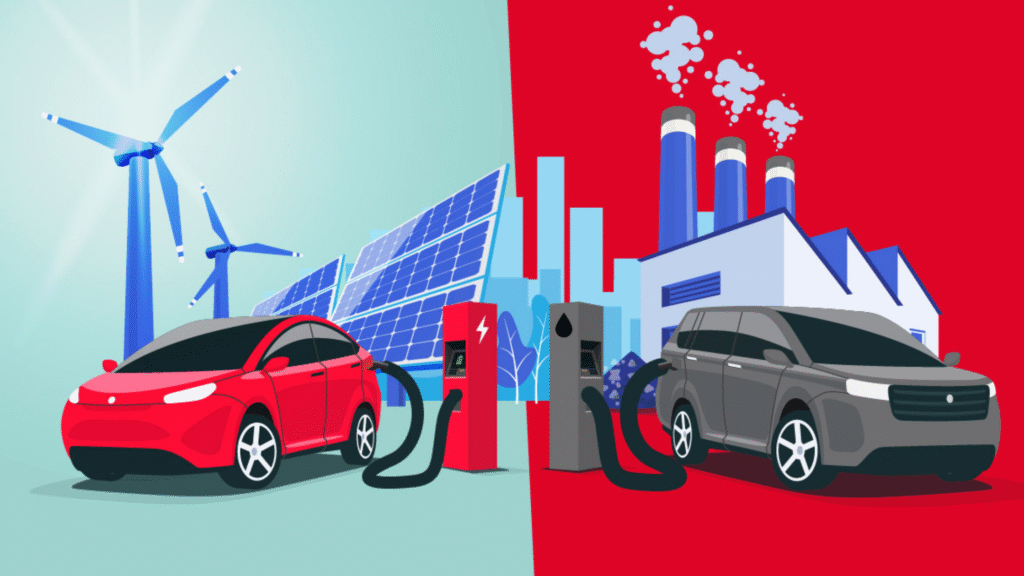
The Break-Even Point: As you drive, the EV quickly pays off this carbon debt. Depending on how clean your local electrical grid is (e.g., solar and wind vs. coal and natural gas), an EV typically becomes cleaner than a hybrid after 15,000 to 20,000 miles of driving.
The Hybrid Alternative: If your local grid relies heavily on coal, a highly efficient hybrid or PHEV can actually perform comparably to an EV in terms of overall lifecycle greenhouse gas emissions over the first few years of ownership.
Pros and Cons: A Quick-Reference Guide
To help you visualize the matchup of Hybrid vs Electric Cars: Which One Should You Buy?, let’s look at the direct trade-offs of each system.
Traditional & Plug-In Hybrids
Pros:
No range anxiety; fueled by easily accessible gasoline.
Lower initial purchase price compared to most EVs.
Perfect for drivers without access to home charging.
PHEVs offer pure electric driving for short daily commutes.
Cons:
Still require traditional engine maintenance (oil changes, spark plugs).
Still produce tailpipe emissions (except when a PHEV is in electric mode).
Subject to volatile gasoline prices.
Battery Electric Vehicles (EVs)
Pros:
Zero tailpipe emissions and a significantly lower carbon footprint over time.
Instant torque delivers incredibly smooth, quiet, and rapid acceleration.
Drastically lower maintenance costs (no oil changes, fewer moving parts).
Extremely cheap to operate if charging at home.
Cons:
Higher upfront purchase price (though offset by incentives and fuel savings).
Public charging infrastructure can still be inconsistent in remote regions.
Charging takes longer than pumping gas.
Cold weather can temporarily reduce battery range by 20% to 30%.
Making Your Decision: Which One Should You Buy?
To finalize your decision on Hybrid vs Electric Cars: Which One Should You Buy?, take a moment to evaluate which of the following profiles matches your lifestyle.
Buy a Hybrid (or PHEV) if:
- You cannot charge at home: If you rely entirely on street parking or live in an apartment without dedicated charging, a hybrid will save you time and frustration.
- You take frequent, spontaneous road trips: If you regularly drive hundreds of miles into remote areas with limited infrastructure, the hybrid’s flexibility is unmatched.
- You want to keep upfront costs low: If you are working with a tighter budget and want immediate fuel savings without paying a premium for a large battery pack.
Buy an Electric Car (EV) if:
- You can charge at home or work: Having a reliable, cheap place to plug in daily transforms the EV ownership experience into pure convenience.
- Your daily commute is predictable: If your daily driving falls well within the 250-to-400-mile range of modern EVs, you will rarely need to use public chargers.
- You want to minimize maintenance and emissions: If you are tired of oil changes, spark plugs, and trip-to-the-mechanic anxiety, and you want the cleanest environmental footprint possible.
Both paths represent a massive step forward from traditional, gas-only vehicles. Whichever route you choose, you are investing in a more efficient, technologically advanced, and environmentally conscious future.